
Computational Resources
OCTOPUS500 High-Performance Computing Cluster Guidelines and Reference.
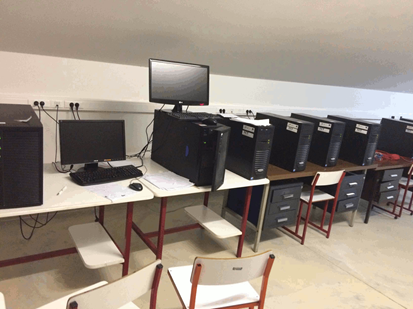
At ClusterDEM, we leverage advanced computational power to support our research in numerical modeling and simulation. Our mini HPC system, OCTOPUS500, provides robust parallel computing architecture tailored for heavy engineering solvers.
- Core Count: 768 Compute Cores
- Memory capacity: 2TB of High-Speed RAM
- Operating System: CentOS Platform
- Cluster Build Layout: ROCKS Cluster Distribution
Running Your Case on OCTOPUS500
To efficiently utilize the shared cluster environment, all researchers must adhere strictly to the core environment mappings defined below.
Available Parallel Environments
OCTOPUS500 relies on parallel tracks structured as mpiX, where X marks the exact allocation allocation bounds of CPUs deployed per cluster node (scaling systematically from 1 to 10). You must configure your script allocation slots as an exact multiple of X.
-pe mpi5 25Launches a balanced track using 5 compute nodes with 5 CPUs mapping each.
-pe mpi5 22  # Incorrect: Not a multiple of 5
-pe mpi2 5   # Incorrect: Not a multiple of 2
Cluster Node Selection
Target specific hardware strings directly by passing the core node handle parameter:
-l h=compute-0-x
Replace x with the specific target slot index identifier assigned to your tracking job.
Job Submission & Management
Submitting a Job
Queue up compilation script arrays running the baseline scheduler submission handle:
qsub RUN.sh
SGE engine environments will throw back an confirmation echo array identifying task parameters: Your job 624556 ("myjob.cmd") has been submitted.
Example OpenFOAM Submission Script
Deploy the boilerplate environment submission script below, ensuring modifications are passed inside target tracking cases.
#!/bin/bash
#$ -S /bin/bash
#$ -pe mpi5 10
#$ -cwd
#$ -N MySimulation
#$ -o log
#$ -e error.err
#$ -p 0
#$ -M youremail@ubi.pt
#$ -m bea

# Source environment parameters
. $HOME/OpenFOAM/OpenFOAM-2.0.x/etc/bashrc

# Arguments tracking configuration
ARGS="--mca btl ^openib --mca btl_tcp_if_include eth0"

# Execute solver runtime target
SOLVER=clusterMHDFoam
mpirun -np $NSLOTS $ARGS $SOLVER -parallel
SGE Commands Reference Guide
Quick directory tracking standard Sun Grid Engine (SGE) system parameters:
| Command Syntax | System Context Operation Description |
|---|---|
qsub RUN.sh |
Submit a pipeline batch script configuration down the scheduling path rows. |
qstat / qstat -u username |
Check computing queues runtime status indexes or filter specifically by user. |
qhost / qhost -j / qhost -q |
Display architecture compute nodes details, metrics bounds, or active lines. |
qdel [job_id] / qdel -f [job_id] |
Cancel or explicitly pass force termination signals down running system nodes. |
qhold [job_id] |
Hold a specific queued job array inside structural lines buffer boundaries. |
qrls [job_id] |
Release a held job instance framework allocation back to scheduling pipelines. |
man qsub.